
Premature scaling remains the single most common cause of commercial failure. When organizations miss revenue targets on a new product release, leadership routinely blames marketing execution or sales effort. In reality, the breakdown almost always occurs upstream: the organization pushed an offering into the market before validating the baseline operational, economic, and distribution prerequisites.
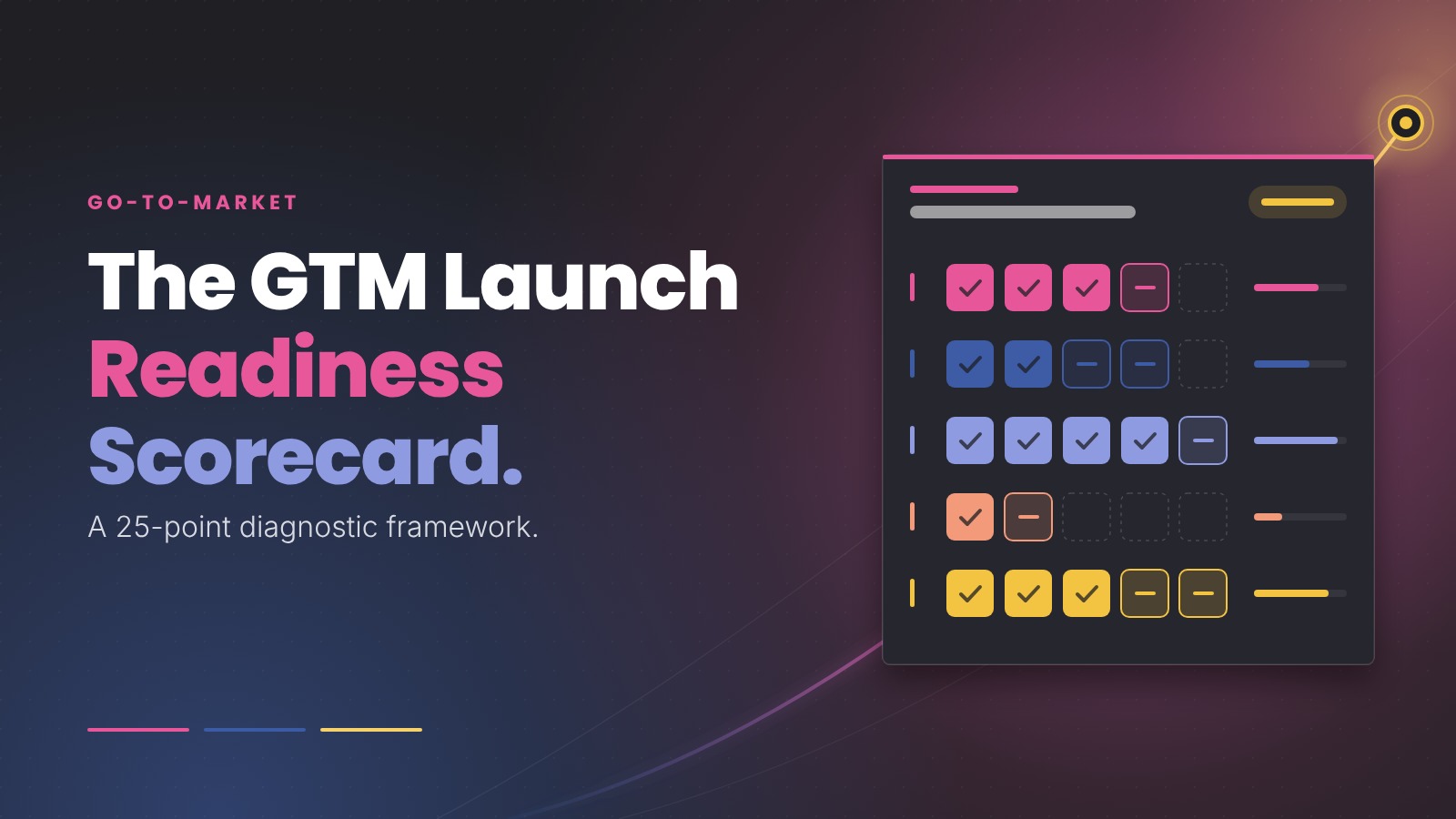
To prevent this, commercial teams need an objective, binary audit rather than anecdotal confidence. The Trebuchet GTM Launch Readiness Scorecard evaluates 25 distinct diagnostic criteria across five commercial pillars. It provides founders, revenue leaders, and product marketers with a definitive read on whether an offering is structurally prepared to scale, needs conditional remediation, or must be held back from release.
The Scoring System
Evaluate each of the 25 criteria below using a strict three-point scale:
- 0 (Deficient): Not addressed, undocumented, or based purely on internal assumptions.
- 1 (Emerging): Partially built or validated via qualitative feedback, but lacks systematic instrumentation or stress-testing.
- 2 (Validated): Fully documented, mechanically tested, supported by empirical customer data, and staffed with designated owners.
A perfect score is 50 points. A score below 35 signals a high probability of capital burn without sustainable customer acquisition.
Pillar 1: Market & Customer Validation (Points 1–5)
Launches fail when built around internal product timelines rather than external buyer realities. This pillar measures the precision of your target profile and your direct exposure to genuine demand.
- Narrow ICP Definition: You have identified not just a vertical, but a specific company profile, tech stack condition, and buyer trigger event where the problem is acute and funded.
- Validated Economic Buyer Access: You have conducted discovery interviews with at least 20 budget holders (not merely end-users) who have validated that the problem ranks among their top three operational priorities for the current fiscal cycle.
- Documented Buying Center Dynamics: You have mapped the decision-making unit, including the internal champion, technical evaluator, procurement gatekeeper, and sign-off thresholds.
- Competitive Displacement Architecture: You have identified what current solution—including spreadsheets, workarounds, or inertia—you are actively replacing, and can articulate a 10x delta on a single, critical dimension.
- Regulatory & Compliance Clearances: All industry-specific requirements (e.g., SOC 2, HIPAA, FDA clearance, retail packaging compliance) are finalized, not pending.
Pillar 2: Positioning, Packaging, and Unit Economics (Points 6–10)
Messaging must withstand the pressure of market skepticism, and pricing models must support customer acquisition costs (CAC) at scale.
- Quantified Value Proposition: Your core messaging quantifies impact in specific business metrics (hours saved, risk eliminated, revenue unlocked) rather than abstract features.
- Defensible Pricing Architecture: Pricing tiers reflect value metrics that scale as the customer gets more utility, rather than arbitrary cost-plus or defensive undercutting.
- Unit Economic Guardrails: You have modeled your expected Lifetime Value to Customer Acquisition Cost (LTV:CAC) and payback period, with acceptable payback under 12 months for mid-market and under 18 months for enterprise.
- Standardized Contracts and MSAs: Contracts, terms of service, and service-level agreements (SLAs) are standardized and approved by legal counsel to eliminate bespoke sales friction.
- Proof Points and Pilot Evidence: You possess at least two documented, referenceable case studies or paid pilot results demonstrating realized return on investment.
"A launch is not a marketing moment; it is a stress test of your company's end-to-end commercial architecture. If the pipes leak, pouring more demand into the top will simply accelerate your burn rate."
Pillar 3: Demand Generation & Funnel Mechanics (Points 11–15)
A predictable launch requires distinct inbound and outbound channels tested for efficiency prior to full commercial release.
- Primary Demand Channel Validation: At least one acquisition channel (e.g., targeted account outbound, performance search, partner ecosystem) has produced pipeline at an acceptable cost per qualified opportunity.
- High-Converting Landing Experiences: Digital touchpoints, product pages, or retail shelf designs have undergone message testing with clear, single-action conversion pathways.
- Content Engine Mapped to Buyer Journey: You have dedicated collateral for every stage of the funnel: problem-framing top-of-funnel assets, comparative middle-of-funnel guides, and security/ROI calculators for late-stage deals.
- Integrated Lead Routing: Inbound inquiries route automatically to the appropriate account executive or SDR in under five minutes, with zero manual spreadsheet handoffs.
- Attribution & Analytics Baseline: Closed-loop reporting is fully configured in your CRM and marketing automation platform to track deal velocity and source performance from click to cash.
Pillar 4: Sales Enablement & Channel Distribution (Points 16–20)
Your sales reps, distributors, or channel partners must be trained to sell the new offering without direct executive intervention.
- Repeatable Discovery Playbook: Sales reps have a standardized discovery guide that surfaces the specific pain points your solution solves, including qualification disqualifiers.
- Objection-Handling Battlecards: Teams are armed with specific scripts and comparative matrices addressing the top five competitor counter-arguments and commercial objections.
- Interactive Demo or Sample Protocol: Demos are scripted around customer outcomes rather than product tours; physical products have secure, automated sampling mechanisms.
- Channel Partner Incentives: If selling through brokers, distributors, or system integrators, partner margins, co-op marketing dollars, and registration programs are operational.
- Rep Certification: 100% of the active sales team has completed live roleplays and passed certification on positioning, qualification, and closing techniques.
Pillar 5: Operational Delivery & Customer Retention (Points 21–25)
Acquiring a customer is a liability until that customer successfully onboards, activates, and experiences value.
- Standardized Onboarding Protocol: You have documented a step-by-step implementation plan that drives the customer to First Value Delivery within 14 days of contract signature.
- Customer Success Ownership: A dedicated resource or clear internal escalation path is assigned for onboarding, adoption tracking, and proactive intervention.
- Telemetry & Health Scoring: Product usage metrics, consumable replenishment rates, or support ticket volumes are monitored systematically to identify churn risk before renewal discussions.
- Fulfillment & Supply Chain Redundancy: For physical goods or hardware, manufacturing capacity and logistics can fulfill a 3x surge over forecast without inventory stockouts.
- Feedback Loop Integration: A formal, weekly feedback cadence connects sales, customer success, and product engineering to address product deficits exposed in the wild.
Interpreting Your Launch Readiness Score
Total your score across all 25 points (maximum 50) to determine your operational readiness:
42 to 50 Points: Fully Validated (Green Light)
The commercial engine is insulated against structural failure. Go to market with full resource allocation, activate paid demand generation, and begin aggressive channel scaling. Focus leadership reviews on sales velocity and expansion cohorts.
32 to 41 Points: Conditional Release (Amber Light)
Significant operational or distribution vulnerabilities remain. Limit the launch to a restricted release, closed beta, or regional pilot. Do not commit heavy outbound advertising spend or sign enterprise SLAs until the lagging criteria reach a Level 2 validation.
Below 32 Points: Launch Halting State (Red Light)
The product is fundamentally unprepared for scale. Deploying the product in this state will damage market reputation, exhaust sales morale, and inflate customer acquisition costs. Halt launch activities and return to discovery, messaging alignment, and operational setup.
Executing the Diagnostic
Run this assessment as a mandatory pre-mortem across product, marketing, sales, and operations leadership. Force consensus on every point: if an account executive and a product marketer disagree on whether the positioning is validated, score it a zero.
Sustainable commercial success does not come from marketing volume or executive optimism. It is the output of systematic alignment across every component of the revenue engine before the launch date arrives.