
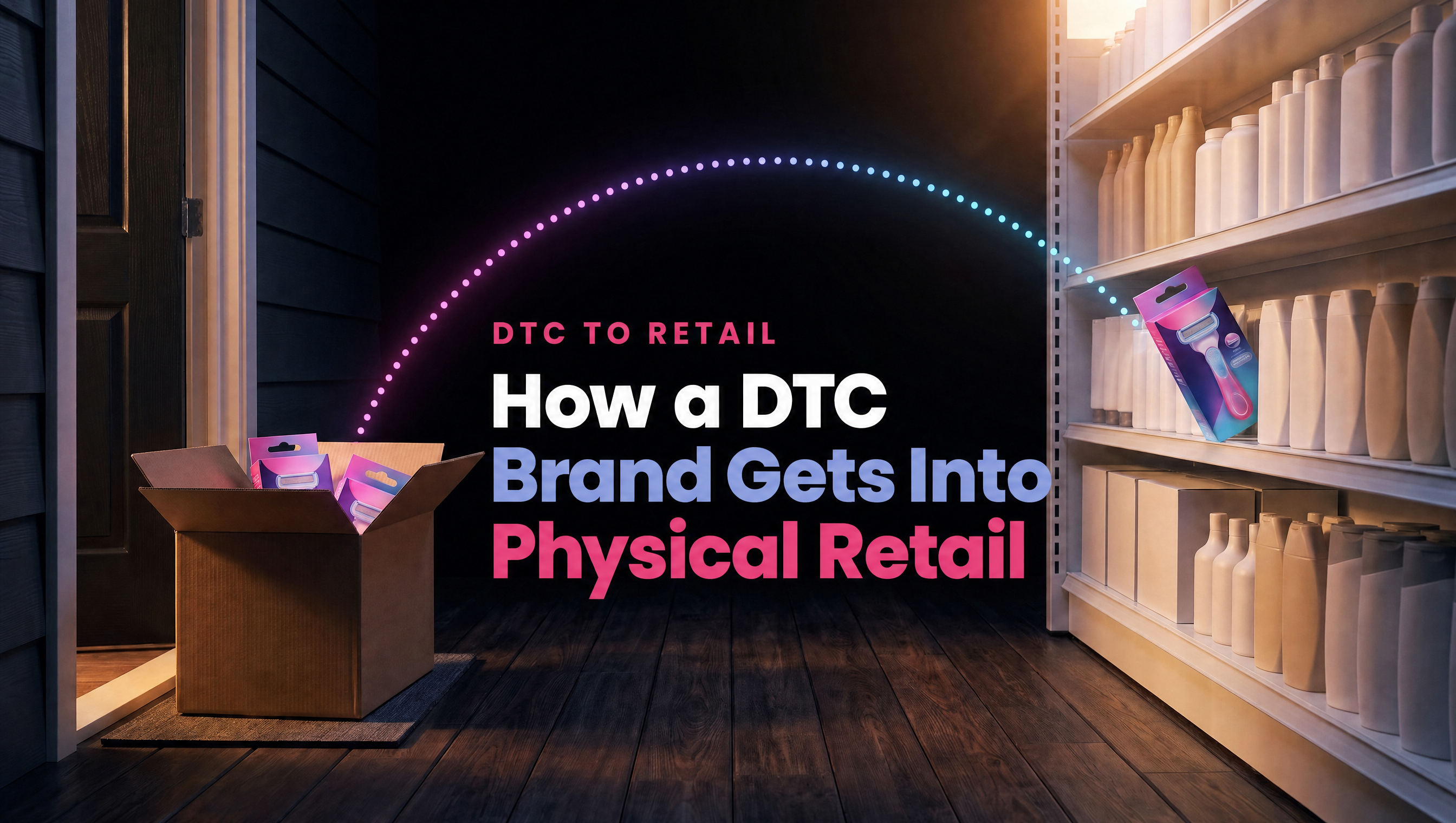
Answer first. A DTC brand is ready for physical retail when it can show repeatable demand, a margin that survives wholesale pricing, operations that can fill a retail order, and cash to fund marketing after the product lands. From there, entry follows a sequence: pick the right first retailer, build the economics, pitch with evidence, bring in the partners the account requires, drive shoppers to the shelf, and let sell-through data decide whether you expand.
This guide walks through that sequence in order.
Step 1: Check whether you are ready, honestly
Buyer interest feels like a green light. It is not one yet. Before you pitch, pressure-test four things.
| Question | Good sign | Warning sign |
|---|---|---|
| Demand: Do people buy without a discount? | Repeat purchase and steady full-price sales outside launch spikes | Sales track closely with promo codes or one paid channel |
| Margin: Can you afford the middle? | Your cost of goods leaves room after the retailer's and any distributor's share | Your DTC margin only works because you keep the whole shelf price |
| Operations: Can you fill a retail order? | Supply for a full order plus reorders, retail-ready packaging, barcodes in place | One production run away from stocking out |
| Funding: Can you pay for the launch after the PO? | Budget set aside for launch media, promotions, and slow early payment terms | The purchase order is the funding plan |
Two warning signs do not mean never. They mean fix these first.
Step 2: Choose your first retail route
Retail covers very different businesses. Your first route should match your brand's stage, not your ambition for year five.
| Route | Suits brands that | Trade-off |
|---|---|---|
| Independent and specialty stores | Want a proving ground with a close-fit shopper | More accounts to manage for fewer units each |
| Regional chains | Have early proof and can support a focused geography | Tighter requirements and a real sell-through test |
| National retailers | Have strong evidence, supply, and launch funding | Highest stakes; a weak first season is hard to recover from |
| Owned pop-ups or stores | Want shopper insight and brand control | You carry rent, staff, and inventory risk yourself |
Most brands should start narrower than they want to. A strong result in 50 doors is a better pitch than a mediocre one in 500.
Step 3: Do the math before a buyer does it for you
Retail pricing works backward from the shelf. Here is a simple example. The numbers are illustrative assumptions, not industry averages. Your category, retailer, and terms will differ.
| Line | Illustrative figure |
|---|---|
| Shelf price | $20.00 |
| Retailer margin (assumed 40%) | $8.00 |
| Price the retailer pays | $12.00 |
| Distributor share (assumed 20% of $12.00) | $2.40 |
| What you receive per unit | $9.60 |
| Your cost of goods (assumed) | $5.00 |
| Gross profit per unit, before promotions and marketing | $4.60 |
Then subtract what the launch actually costs: promotional discounts, slotting or program fees, freight, and marketing. If the number left makes you wince, better to feel it now than after the PO.
Step 4: Build the story a buyer can repeat
A buyer who likes your product still has to defend it to their category team. Give them what they need: who buys your product, why it earns space over what is already on the shelf, the evidence it sells, and your plan to drive shoppers to it. Lead with that last one. A buyer's biggest worry about a DTC brand is that its demand lives online and will not follow it into the aisle.
Step 5: Line up the partners the account requires
Some retailers buy direct. Many expect product to arrive through a distributor, and brokers can open doors and manage accounts. Each partner takes a share, so bring them in because the account requires it, not by default. Check each retailer's own supplier requirements before you promise delivery. Registering as a supplier is not the same as having an agreement.
Step 6: Fund the launch, not just the listing
Getting authorized is the start of the test. Plan the marketing that sends shoppers to specific stores: local paid social and search, retail media on the retailer's own platforms, in-store promotion, and telling your existing DTC customers where to find you. Your online audience is your unfair advantage here. Use it.
Step 7: Read the sell-through, then decide
Set your scorecard before launch: units per store per week, sell-through against what the retailer expects, reorder timing, and margin after promotions. Those numbers tell you whether to expand, fix, or pull back, and they are the core of your pitch to the next retailer.
Where brands most often slip
Pricing wholesale off the DTC margin instead of working back from the shelf.
Saying yes to more doors than the launch budget can support.
Treating the buyer meeting as the finish line.
Assuming online fans will find the product in store without being told where.
Want a second opinion on your plan?
Trebuchet's free Retail Readiness Assessment looks at your demand, pricing, materials, and operations, and tells you whether to pitch now or what to fix first.